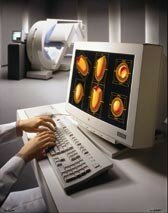
Nuclear Medicine uses extremely small amounts of radioactive compounds in order to image and assess the function and state of health of many of the body's internal organs, and to treat some forms of cancer. It is a multidisciplinary field dependent upon contributions from Physics, Chemistry and Medicine. This highly sophisticated discipline is at the forefront of discovering and understanding the complex physiologic processes of our bodies. This discipline is of enormous importance to medical specialties such as Cardiology (heart), Neurology (nervous system), Oncology (cancer), Orthopedics (bone), Endocrinology (hormone system), Hematology (blood), Nephrology (kidney), and Pulmonology (lung).
A typical nuclear medicine study involves the introduction of an extremely small quantity of a radioactively labeled compound into the body - most often by injection into a vein in the arm. Nuclear Medicine is able to provide unique functional information about virtually every major organ system within the body.
The ability to produce functional images and quantify physiologic processes at a molecular level distinguishes Nuclear Medicine from other imaging modalities such as Radiography, Medical Sonography and Magnetic Resonance Imaging.
Nuclear Medicine procedures are extremely safe; involve little or no patient discomfort and require no sedation or anesthesia.
Clinical career opportunities are exceptional ranging from positions as staff technologists, to supervisory posts and department managers. Other positions are available in specialty areas as research technologists, PET technologists and educators. Nuclear Medicine technologists may also pursue openings in the field of Radiopharmacology, or with the manufacture, design and sales of gamma camera and specialized electronics.
Nuclear Medicine is one of the fastest growing allied health professions. Employment of nuclear medicine technologists is expected to grow faster than the average (increase of 36% or more) through the year 2012. Median annual earnings of nuclear medicine technologists in 2002 were $48,210 in general medical and surgical hospitals. Technologists who provide after-hours coverage on an on-call basis can expect to earn additional income. This field is in high demand and certified technologists can find opportunities with government institutions, large private hospitals, small outpatient clinics, temporary staffing agencies, as well as employment in areas such as administration, education, research or business (sales, marketing and technical applications).
|